
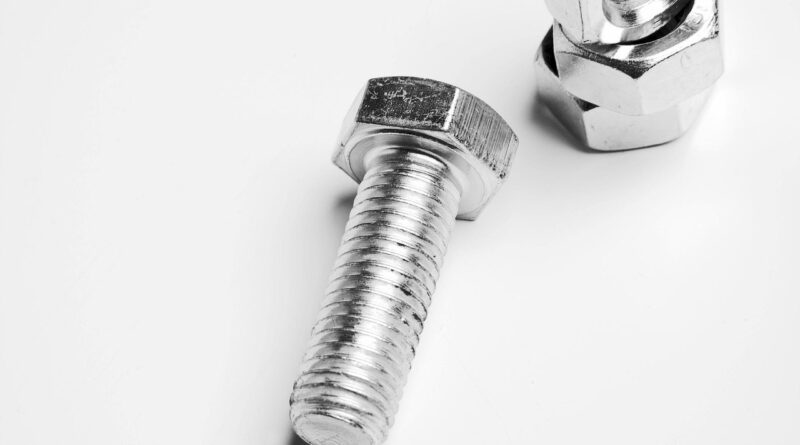
Stainless steel toggle bolts for hollow walls and corrosion-prone spaces
What stainless steel toggle bolts are used for
Stainless steel toggle bolts are hollow-wall anchors that pair a machine-threaded bolt with a folding wing, spring toggle, or metal channel that opens behind the wall. They are used when a fastener has to grip from the blind side of drywall, plaster, hollow concrete masonry, tile over backing board, or another cavity-type material.
The stainless steel specification becomes important where corrosion is a realistic concern. Typical examples include bathrooms, garages, exterior-adjacent walls, coastal properties, food-preparation areas, treated wood assemblies, and other locations where humidity or moisture may shorten the service life of plain or lightly plated steel. A toggle spreads load across the back face of the wall, but the wall material still sets the practical limit.
In the broader bolts and fasteners category, toggle bolts sit between light-duty wall plugs and structural anchors. They are not a substitute for fastening directly into framing, engineered backing, or a code-designed anchor system. They are useful where rear access is not available and the load is moderate, close to the wall, and suitable for the substrate.
How a toggle bolt holds in a hollow wall
A toggle bolt works by creating a bearing surface behind the wall. With a traditional spring-wing style, the folded wings pass through a drilled hole and then open inside the cavity. As the bolt is tightened, the wings are pulled against the back side of the panel or hollow masonry face. With a strap or channel toggle, a metal bar is inserted through the hole, rotated flat against the back surface, and held in position by a plastic strap or cap while the bolt is installed.
This changes the failure mode. Instead of relying only on friction in a small drilled hole, the anchor bears against a larger area behind the wall. That is why toggle bolts can outperform simple plastic expansion anchors in many hollow-wall applications. The tradeoff is that they need a larger hole, enough cavity depth for the wing or channel to open, and a wall face strong enough to resist crushing, tearing, or bending.
Concrete Masonry & Hardscapes Association technical guidance describes the same basic principle for hollow concrete masonry units: once inserted into a predrilled hole in the core, the toggle opens and bears against the masonry. That does not make every hollow block wall suitable. Face shell thickness, cell location, block condition, load direction, edge distance, and fixture geometry all affect performance.
Why stainless steel changes the specification
The word “stainless” does not identify one single material. Many commercial stainless fasteners are described as 18-8, 304, 305, or 316 stainless steel. In general use, 18-8 and 304 stainless are common choices for indoor and mildly corrosive environments. Type 316 stainless is often selected where chloride exposure is a concern, including coastal air, deicing salts, pool areas, wash-down spaces, and some chemical environments. Manufacturer corrosion guides, including Simpson Strong-Tie technical material, commonly distinguish 316 stainless as offering higher corrosion resistance than 304 in chloride-rich settings.
For threaded stainless bolts, ASTM F593 is a widely cited U.S. specification covering stainless steel bolts, hex cap screws, and studs. It helps define material and mechanical requirements for certain stainless externally threaded fasteners. A toggle bolt assembly, however, may include a bolt, wing, channel, nut, washer, strap, or cap made from different materials. A package that says “stainless steel bolt” may not mean every component in the anchor assembly is stainless. For damp or corrosive locations, the entire load path should be checked, not only the visible screw head.
Stainless steel also raises compatibility questions. Mixing stainless with carbon steel, zinc-plated components, aluminum, or copper-based metals can create galvanic corrosion risk when moisture and an electrolyte are present. The risk depends on the metals, the surface area ratio, and the environment. In ordinary interior drywall, this may be minor. In wet or coastal exposure, it can become important. When in doubt, keep the anchor, washer, fixture contact surface, and bolt material compatible.
Reading load ratings without being misled
Load ratings for toggle bolts are easy to misread because published numbers may refer to ultimate test loads, allowable loads, shear loads, pull-out loads, or a specific laboratory substrate. A high number on a package is not a guarantee that any wall will safely hold that weight. The substrate, hole quality, fastener spacing, fixture stiffness, and distance of the load from the wall may matter more than the bolt diameter.
USG/CGC construction handbook data for fixture attachment illustrates the issue. For toggle bolts or hollow-wall fasteners installed in 1/2-inch gypsum board, the listed allowable withdrawal and shear values increase with fastener size, but they remain limited by the gypsum panel. Typical listed allowable values include 20 lbf withdrawal and 40 lbf shear for a 1/8-inch fastener, 30 lbf withdrawal and 50 lbf shear for a 3/16-inch fastener, and 40 lbf withdrawal and 60 lbf shear for a 1/4-inch fastener in that specific assembly. These are not universal ratings for every product; they show why gypsum board itself often becomes the controlling material.
| Rating term | What it usually means | Why it matters |
|---|---|---|
| Ultimate load | The load reached in a test before failure | It is not the same as a safe working load |
| Allowable load | A reduced value intended for design or guidance | It is more useful than ultimate load for real installations |
| Shear load | Load acting mostly downward along the wall face | Common for shelves, brackets, and wall-mounted fixtures |
| Tension or withdrawal load | Load pulling the anchor away from the wall | Critical for cantilevered brackets and objects that project outward |
| Substrate-specific rating | Rating based on drywall, block, tile, steel, or another base material | The number should not be transferred to a different wall type |
Some toggle anchor manufacturers publish ultimate test values and then recommend using only a fraction of that number as a working load. This is a practical reminder, not a universal engineering rule. If the item is heavy, overhead, safety-related, subject to vibration, or likely to injure someone if it falls, the conservative answer is to fasten into framing, blocking, masonry designed for the load, or an engineered anchor system.
Where stainless toggle bolts make sense
Stainless steel toggle bolts are most useful where both blind-side anchoring and corrosion resistance are needed. Common applications include stainless bathroom accessories on hollow walls, utility-room brackets, garage storage components exposed to humidity, exterior wall interiors with condensation risk, and light-duty fixtures on hollow block where a conventional expansion plug would not grip reliably.
They can also be useful when appearance and long-term serviceability matter. A stainless bolt head is less likely than plain carbon steel to show red rust staining around a visible fixture. In public-facing interiors, kitchens, wet rooms, and light industrial spaces, that can be a meaningful difference even when the load is not large.
There are also cases where toggle bolts are the wrong solution. Do not rely on drywall toggle bolts for grab bars, suspended loads over people, heavy cabinets without backing, large TV mounts that project on articulating arms, seismic restraints, or vibrating equipment. FEMA nonstructural component guidance warns against anchoring heavy or safety-critical items only to gypsum board or plaster. In those situations, the load should be transferred to studs, blocking, structural framing, concrete, or masonry designed to receive the anchor. See also: Fittings & Valves.
Choosing between wing, strap, molly, and other anchors
The correct anchor depends on the wall and the fixture, not only the weight printed on the package. Traditional spring-wing toggle bolts are simple and strong for many hollow-wall tasks, but the wing usually falls into the cavity if the bolt is removed. They also require a hole large enough for the folded wing. Strap or channel toggles often need a smaller hole for comparable bolt sizes, can remain in place while the fixture is removed, and are easier to align during installation. Molly bolts expand a sleeve behind the wall and can work well in drywall or plaster, but they need the correct grip range for the wall thickness and can deform weak panels if over-tightened.
| Anchor type | Strengths | Limitations |
|---|---|---|
| Spring-wing toggle bolt | Simple, widely available, good bearing area behind hollow walls | Large hole; wing is usually lost if the bolt is removed |
| Strap or channel toggle | Good alignment; fixture can often be removed and reinstalled | More parts; product-specific hole size and grip range must be followed |
| Molly bolt | Can leave a threaded sleeve in the wall; neat for medium fixtures | Requires correct wall thickness; less forgiving if set poorly |
| Direct fastening to stud or blocking | Best load path for heavy fixtures | Requires locating framing or adding backing |
| Masonry expansion or screw anchor | Useful in solid concrete or solid masonry | Not the same as a hollow-wall toggle; may fail in hollow cells if misapplied |
For stainless applications, also compare the visible head style, thread size, washer material, and fixture contact area. A stainless bolt paired with a non-stainless washer may still stain the surface. A small head may need a stainless washer to distribute pressure on a slotted bracket. If the fixture will be removed regularly, a channel-style toggle is usually more serviceable than a spring-wing toggle.
Installation details that affect performance
Good installation is as important as anchor selection. Start by identifying what is behind the wall: studs, plumbing, wiring, insulation, masonry cells, tile backing, or air gaps. A toggle needs enough open space to deploy. If it hits a stud, pipe, or solid obstruction, it may not open fully, and the installation can feel tight while still being unreliable.
- Use the specified drill size. Oversized holes reduce bearing and may allow the anchor to rotate or pull through.
- Confirm wall thickness and grip range. Strap toggles and molly-style anchors are especially sensitive to thickness limits.
- Keep the load close to the wall. A projecting shelf bracket creates tension at the upper anchors and can overload drywall even when the item is not extremely heavy.
- Avoid over-tightening. Crushing gypsum board or tile backing weakens the connection and can start hidden cracking.
- Space anchors properly. Closely grouped toggles can damage the same small area of wall instead of sharing load effectively.
- Check the fixture, not just the anchor. Thin brackets, soft washers, and oversized slots can become the weak point.
For hollow concrete masonry, drill location matters. The toggle must open inside a void and bear on sound material. Drilling too close to an edge, mortar joint, web, crack, or damaged face shell can reduce holding strength. For exterior or damp masonry, stainless components may help with corrosion, but water management and substrate condition still control long-term reliability.
Practical selection checklist
Before choosing stainless steel toggle bolts, run through a short checklist. First, define the load: weight, direction, movement, and whether people could be injured if the fixture falls. Second, identify the substrate: 1/2-inch drywall, 5/8-inch drywall, plaster, tile over board, hollow block, or another assembly. Third, decide whether corrosion exposure justifies 304, 316, or another stainless grade. Fourth, verify that every important component in the anchor assembly is compatible with the environment.
Next, compare the required hole size with the fixture. Some fixtures have small mounting plates that cannot hide the hole required for a large spring-wing toggle. In that case, a strap toggle or a different mounting method may produce a cleaner result. Finally, decide whether future removal matters. If the fixture may be serviced or replaced, a toggle that stays captured behind the wall can save repair work.
The safest rule is to treat toggle bolt ratings as guidance for a specific wall assembly, not as universal capacity. Stainless steel improves corrosion resistance; it does not make weak drywall stronger. When the wall material is questionable or the load is important, add blocking, hit framing, or use an anchor system designed for the base material.
Frequently asked questions
Are stainless steel toggle bolts stronger than zinc-plated toggle bolts?
Not automatically. Stainless steel mainly improves corrosion resistance. Strength depends on the bolt size, stainless alloy, thread condition, wing or channel design, substrate, and installation quality. In many hollow-wall applications, the drywall or masonry face fails before the metal bolt reaches its material limit.
Should I choose 304 or 316 stainless toggle bolts?
For dry interior rooms, 304 or common 18-8 stainless is often adequate. For coastal air, chlorides, pool areas, frequent wash-down, or more aggressive moisture exposure, 316 stainless is generally the more corrosion-resistant choice. Always check whether the wing, channel, nut, and washer match the stated stainless grade.
Can toggle bolts hold a TV mount?
They may hold some flat, lightweight fixtures when the mount manufacturer permits that substrate, but they are a poor default for heavy or articulating TV mounts. An arm that pulls the screen away from the wall greatly increases tension on the upper fasteners. Fastening into studs, blocking, or a rated structural backing is the more reliable approach.
Can stainless toggle bolts be used in hollow concrete block?
Yes, some toggle bolts can be used in hollow concrete masonry when the toggle opens inside the cell and bears against sound masonry. The specific product must be suitable for the hole size, cell space, face shell condition, and load direction. Solid concrete anchors and hollow-wall toggles are not interchangeable.
Why did my toggle bolt spin or fail to tighten?
The most common causes are an oversized hole, insufficient tension while tightening, an obstruction that prevents the wing from opening, a wall thickness outside the anchor grip range, or damaged wall material. Remove the load, inspect the hole if possible, and do not assume a spinning anchor will become safe by further tightening.


